

.jpg)
.jpg)


 СН4 мал 200.jpg)



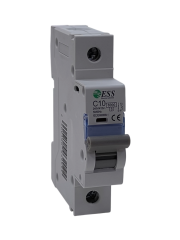
Circuit breaker ESS-63, MSLB 1.2, 3P 1-63A (ESS-63 1P 63A)


⚡ ESS-63 1P C63 — electrical circuit protection
The ESS-63 1P C63 miniature circuit breaker protects wiring against overloads and short circuits. It disconnects the protected circuit when dangerous overcurrent occurs.
✅ Key features
- 63 A rated current. For circuits with cables and equipment rated for the corresponding load.
- Single-pole design — 1P. Disconnects one conductor. In a single-phase installation, it switches the live conductor according to the distribution board design.
- Type C tripping characteristic. Defines its response to elevated current, including brief starting currents.
- 6 kA breaking capacity. Indicates the short-circuit current the breaker can interrupt under specified conditions.
📋 Technical specifications
| Brand / series | ESS / ESS-63 |
| Number of poles | 1P |
| Rated current | 63 A |
| Tripping characteristic | C |
| Breaking capacity | 6 kA |
| Rated voltage | 240 V AC |
| Frequency | 50/60 Hz |
🏠 Applications
For residential and commercial distribution boards serving circuits designed for protection by a 63 A breaker. Suitability as an incoming breaker depends on the electrical design, authorised supply capacity and utility requirements.
Do not replace a lower-rated breaker with a 63 A model without checking the wiring. Selection must consider cable size and material, installation method, load and prospective short-circuit current.
🛡️ Additional protection
Residual current protection requires an RCD or RCBO. Overvoltage and undervoltage monitoring require a voltage monitoring relay. These devices must be selected separately.
Explore circuit protection devices and electrical supplies for distribution boards at Schetchik.uz.
Selection and installation must be carried out by a qualified electrician.
❓ ESS-63 1P 63A frequently asked questions
What does 1P 63A mean?
1P means single-pole: the breaker disconnects one conductor. 63A is its rated current of 63 amperes. A small increase above 63 A does not necessarily cause immediate tripping; operating time depends on the current and tripping characteristic.
Can it be used as an incoming breaker?
Yes, where permitted by the electrical design, authorised supply capacity, incoming cable rating and supply arrangement. A single-pole breaker disconnects only one conductor and is not suitable for every incoming supply arrangement.
How much power does 63 A correspond to?
At 230 V and a power factor close to one, 63 A corresponds to approximately 14.5 kW. This is a calculation, not permission to connect that load: wiring, authorised supply capacity and installation conditions must also be considered.
What cable size is needed for a 63 A breaker?
There is no universal cable size. Selection depends on conductor material, installation method, temperature, number of loaded conductors and other conditions. The cable and breaker must be selected together through proper calculation.
What does Type C mean?
It defines how the breaker responds to elevated current. Selection must account for equipment starting currents and sufficiently fast short-circuit disconnection in the specific circuit.
What is the difference between 63 A and 6 kA?
63 A is the breaker’s rated operating current. 6 kA is its short-circuit breaking capacity under specified conditions. They describe different properties of the device.
Does it replace an RCD and a voltage monitoring relay?
No. An RCD detects residual current, while a voltage monitoring relay responds to unacceptable voltage. ESS-63 provides overload and short-circuit protection. The required protective devices depend on the electrical design.
Can it replace a 25, 32 or 40 A breaker?
Only after checking the installation and updating the design where necessary. Simply fitting a 63 A breaker may allow the wiring to overheat without timely disconnection.
Can one 1P breaker protect a three-phase circuit?
A single-pole breaker does not disconnect all three phases simultaneously. A three-phase circuit requires a suitable multipole device selected according to the circuit design and protection requirements.
What should I do if it trips or becomes very hot?
Stop using the circuit if there is a burning smell, casing discolouration or excessive heat. Possible causes include overloads, loose connections or a fault. Do not increase the rating or repeatedly reset the breaker before an electrician checks it.


 Circuit breaker ESS B1-125 3P 80-63A 35kA (63A)


 Current transformer TTE-A-300/5A accuracy class 0.5 EKF PROxima


 Выключатель автоматический ESS в литом корпусе NXB-63 1P C25 6kA


 Выключатель автоматический Chanan Dz47-63/C50. 1P