


.jpg)
.jpg)


 СН4 мал 200.jpg)



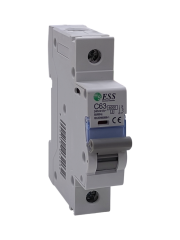
Circuit breaker ESS-63, MSLB 1.2, 3P 1-63A (ESS-63 1P 10A)


⚡ ESS-63 1P C10 miniature circuit breaker
ESS-63 1P C10 protects electrical circuits against overloads and short circuits. It disconnects the protected circuit when excessive current occurs, helping prevent damage to wiring.
✅ Key features
- 10 A rated current. Select according to cable current capacity and connected load.
- Single-pole design — 1P. Disconnects one conductor. In a single-phase circuit, it is used to disconnect the live conductor according to the distribution board design.
- Type C tripping characteristic. Defines the breaker’s response to brief current surges and short circuits.
- 6 kA breaking capacity. Indicates the short-circuit current the breaker can interrupt under specified conditions.
📋 Technical specifications
| Brand / series | ESS / ESS-63 |
| Number of poles | 1P |
| Rated current | 10 A |
| Tripping characteristic | C |
| Breaking capacity | 6 kA |
| Rated voltage | 240 V AC |
| Frequency | 50/60 Hz |
💡 Applications
Suitable for individual lighting circuits and other circuits with matching requirements. Do not select a breaker by appliance wattage alone: cable capacity, installation method, starting currents and fault disconnection requirements must also be considered.
🛡️ Distribution board protection
A standard circuit breaker does not replace a residual current device, which detects leakage current, or a voltage monitoring relay. Additional protective devices must be selected according to the electrical design.
Explore circuit protection devices and electrical supplies at Schetchik.uz to complete your installation.
Have a qualified electrician select and install the protective devices.
❓ Frequently asked questions
What does 1P 10A mean?
1P means single-pole: the breaker disconnects one conductor. 10A is its rated current of 10 amperes. It does not necessarily trip immediately above 10 A; operating time depends on the current and tripping characteristic.
What can a 10 A breaker be used for?
It may be used for individual lighting circuits and other suitable circuits. Suitability depends on cable current capacity, connected load and circuit protection requirements.
What does Type C mean?
It is the tripping characteristic that defines how the breaker responds to elevated current. Selection must account for appliance starting currents and short-circuit disconnection conditions.
What does 6 kA mean?
It is the breaking capacity: the short-circuit current the breaker can interrupt under specified conditions. It is not the permissible operating current of the load.
How much power can be connected?
At 230 V and a power factor close to one, 10 A corresponds to approximately 2.3 kW. This is an indicative calculation, not a universal limit: cable capacity, load characteristics and installation conditions must also be considered.
Does it provide earth leakage and electric shock protection?
A standard circuit breaker does not include residual current protection. A correctly selected RCD or RCBO is used for that purpose as part of the overall electrical safety system.
Does it protect against voltage surges?
The breaker responds to current and does not replace a voltage monitoring relay or surge protective device. These devices perform different functions and must be selected separately.
Can I replace a tripping 10 A breaker with a 16 A model?
Do not increase the rating without checking the circuit. First identify the cause of tripping and verify cable capacity. A higher-rated breaker may leave the wiring inadequately protected.
What should I do if it trips repeatedly?
Possible causes include overloads, short circuits, faulty equipment or connection problems. Do not repeatedly reset it without identifying the cause. Disconnect the load and have an electrician investigate.


 Circuit breaker ESS B1-125 3P 80-63A 35kA (63A)


 Stream transformer | 1000 /5A 5 - 10VA /SR (OV) 80-1000 Class 0.5


 Current transformer /75 /5A 5 - 10VA /SR (OV) 30V - 75 Class 0.5
 Circuit breaker ESS GB1-125 10KA, MSL8, ESS-63, NXBLE 1-3P, 1-63A (ESSB1-125 3P 80A)
 Current transformer TTE-A-1000/5A accuracy class 0.5 EKF PROxima



 Выключатель автоматический Chanan Dz47-63/C50. 1P

 Выключатель автоматический ESS в литом корпусе NXB-63 1P C25 6kA


