


.jpg)
.jpg)


 СН4 мал 200.jpg)



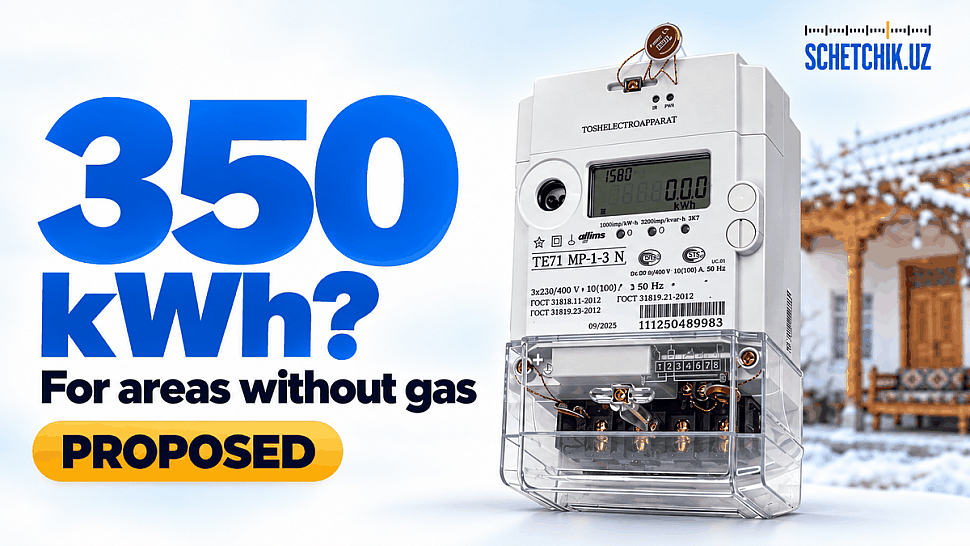
A proposal would increase the winter basic electricity allowance from 200 to 350 kWh in areas without gas supply. We explain what the proposal means, how tariff blocks work and how to estimate an electric heater’s running costs.
An electric heater brings welcome warmth in winter, but also increases electricity consumption. Uzbekistan has proposed raising the winter basic electricity allowance from 200 to 350 kWh in areas without gas supply. Here is what that could mean for a household budget.
📌 Important: The President’s official website reported approval of the proposal on 6 October 2026. That announcement alone does not establish the implementation date or identify every eligible customer account. The calculations below use the tariff schedule with a first block of up to 200 kWh.
Who is the proposed increase intended for?
The proposal concerns areas without gas infrastructure and areas that do not receive gas. It would increase the basic electricity allowance to 350 kWh during the heating season.
This does not mean every household account changes automatically. Application to a particular address must follow the official implementation rules and account classification.
Allowance, tariff and compensation: what is the difference?
- Basic allowance: the consumption volume charged within the first tariff block.
- Tariff: the price per kWh within a particular block.
- Compensation: a separate support mechanism for households meeting the programme’s conditions.
A higher allowance does not mean free electricity. Eligibility for compensation also cannot be established from consumption alone.
⚡ How electricity charges are calculated
Cabinet of Ministers Resolution No. 243 of 15 May 2026 sets the rates applicable from 1 June 2026. The prices below include VAT.
| Portion of monthly consumption | Standard households, UZS/kWh | Eligible electric-stove category, UZS/kWh |
|---|---|---|
| Up to and including 200 kWh | 650 | 325 |
| Above 200 up to 500 kWh | 900 | 450 |
| Above 500 up to 1,000 kWh | 1,100 | 550 |
| Above 1,000 up to 5,000 kWh | 1,600 | 800 |
| Above 5,000 up to 10,000 kWh | 1,900 | 950 |
| Above 10,000 kWh | 2,200 | 1,100 |
The separate column applies to the eligible category of apartment buildings and dormitories centrally equipped with electric cooking stoves. Buying an individual stove or heater does not change an account’s classification.
Each portion of consumption is charged within its own block. Exceeding 200 kWh does not reprice the first 200 kWh at the higher rate.
How much does 350 kWh cost under this schedule?
For a standard household:
200 × 650 + 150 × 900 = UZS 265,000.
For comparison, 200 kWh costs UZS 130,000 and 500 kWh costs UZS 400,000. These are consumption charges before previous debt, payments, compensation or billing adjustments.
♨️ How much could a heater add?
Suppose a 1.5 kW heater actively heats for five hours a day over 30 days:
1.5 × 5 × 30 = 225 kWh.
If other appliances already use 200 kWh per month, total consumption reaches 425 kWh. Under the standard household schedule shown above:
- Without the heater: UZS 130,000.
- With the heater: UZS 332,500.
- Additional cost: UZS 202,500.
Count the time the heating element actually operates. A thermostat may switch heating off periodically, so the time an appliance remains plugged in is not always the time it draws full power.
🧮 Calculate your utility budget
Use the Schetchik.uz utility cost calculator. Select the billing month and applicable conditions, then enter consumption.
Calculate each month separately. Combining several months of consumption into one figure distorts a calculation based on monthly tariff blocks.
How to keep costs under control
- Record meter readings. Compare consumption over periods of equal length.
- Check heating time. Power and actual operating hours affect consumption.
- Reduce heat loss. Address draughts around windows and doors while maintaining required ventilation.
- Review charges. Compare the billing period, readings and payments.
For help choosing metering or heating equipment, contact Schetchik.uz: +998 71 200-18-00.
❓ Frequently Asked Questions
Click or tap a question to reveal the answer ↓
What does the basic electricity allowance mean?
It is the monthly volume charged within the first tariff block. Electricity within it is still paid for: the allowance describes the volume, while the tariff describes the unit price.
Who is the proposed 350 kWh allowance intended for?
The proposal concerns areas without gas infrastructure and areas that do not receive gas, during the heating season. Application to an individual address follows the official implementation rules.
How is UZS 265,000 for 350 kWh calculated?
Using the standard schedule in this article: 200 × 650 + 150 × 900 = UZS 265,000. Compensation and billing adjustments are excluded from this example.
How does the next tariff block apply?
Only consumption within that block receives its rate. The first 200 kWh retain their basic rate under the schedule shown.
How do I calculate consumption from my meter?
For straightforward direct metering, subtract the opening reading from the closing reading. For example, 1,350 − 1,200 = 150 kWh.
How can I estimate a heater’s consumption?
Multiply power in kW by actual heating hours. For example, 1.5 kW × 5 hours × 30 days = 225 kWh.
How do I find the heater’s additional running cost?
Subtract the bill without the heater from the total bill with it. This accounts for the tariff blocks reached by the additional electricity.
How should I compare costs across several months?
Calculate each month separately, then add the amounts. Also compare kWh, period length and appliance operating patterns.
Sources: President’s official announcement, 6 October 2026; Cabinet of Ministers Resolution No. 243, 15 May 2026.


0 comments