


.jpg)
.jpg)


 СН4 мал 200.jpg)



Updated on 11 October 2026. Since 1 June 2026, the base electricity tariff for consumers in tariff groups I, II and IV in Uzbekistan has been UZS 1,100 per kWh, including VAT. The rate was approved by Cabinet of Ministers Resolution No. 243 of 15 May 2026.
To check a business electricity bill, you need to know the tariff group, metering arrangement and contracted consumption volume as well as the base rate. Some consumers are billed according to time of use or special conditions.
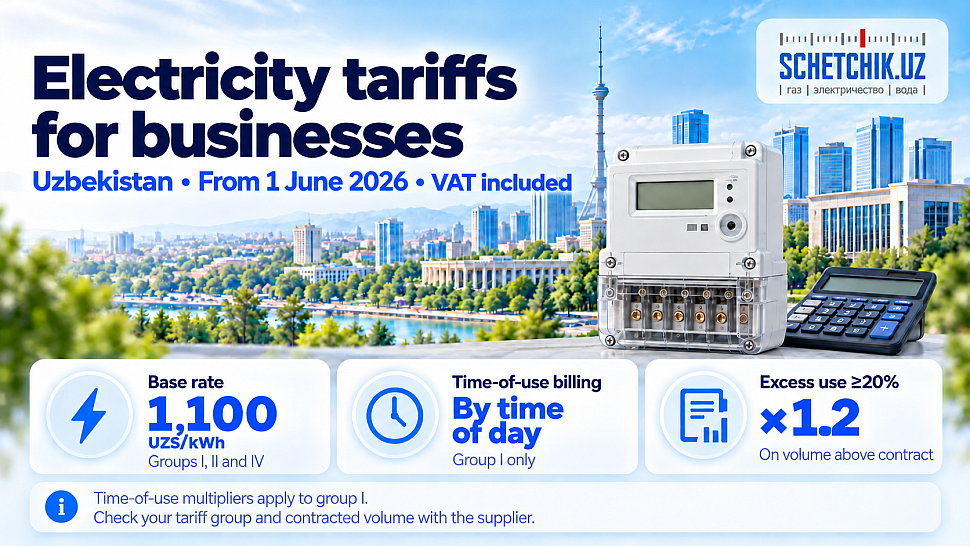
Current electricity rates for legal entities
| Tariff group | Base rate per kWh, including VAT |
|---|---|
| I | UZS 1,100 |
| II | UZS 1,100 |
| IV | UZS 1,100 |
Important: group I uses time-of-use multipliers. Multiplying all consumption by UZS 1,100 therefore does not always produce the final energy charge.
VAT is already included in these rates. Do not add VAT again to the UZS 1,100 tariff.
How to identify your business tariff group
Check the group recorded in your electricity supply agreement and billing documents. Do not determine it solely from the organisation’s name or monthly bill amount.
Under the current rules, group I includes consumers with a combined connected main and backup supply capacity of at least 750 kVA who are billed using differentiated tariffs. Exceptions include budget-funded organisations, water supply organisations and certain pumping stations.
If your agreement and bill show different information, ask the supplier to confirm your group and its legal basis in writing.
Time-of-use rates for group I
The following arrangement reflects the changes introduced in September 2026:
| Period | Time | Calculation from the base rate | Rate per kWh, including VAT |
|---|---|---|---|
| Peak | 06:00–09:00 and 17:00–22:00 | 1,100 × 1.5 | UZS 1,650 |
| Shoulder | 09:00–17:00 | 1,100 ÷ 1.5 | Approximately UZS 733.33 |
| Night | 22:00–06:00 | Base rate | UZS 1,100 |
Check the supplier’s billing documents for rounding of the final charge. This schedule should not automatically be applied to an ordinary group II consumer.
How to calculate an electricity bill
For a simple case with one rate, no excess contracted consumption and no special multipliers, use:
Charge = consumption during the billing period × tariff.
For example, a group II business consumes 4,500 kWh:
4,500 × 1,100 = UZS 4,950,000, including VAT.
With direct metering, consumption is usually the closing reading minus the opening reading. If the meter is connected through instrument transformers, transformation ratios must be taken into account. Check whether the displayed data already includes those ratios to avoid applying them twice.
For group I, calculate the consumption charge for each time band separately, then add the amounts.
What happens when contracted consumption is exceeded?
For non-household consumers, when consumption during the billing period exceeds the contracted volume by 20% or more, the volume above the contract is charged at 1.2 times the applicable tariff.
Example for a group II business: contracted volume is 1,000 kWh and actual consumption is 1,250 kWh. The excess is 25%:
- Within the contracted volume: 1,000 × 1,100 = UZS 1,100,000.
- Excess volume: 250 × 1,100 × 1.2 = UZS 330,000.
- Total: UZS 1,430,000, including VAT.
This example excludes time-of-use rates and other special charges. If you plan to increase your load, discuss an adjustment to the contracted volume with your supplier in advance.
Special arrangements and advance payments
Family enterprises, craftspeople, religious organisations, dormitories, homeowners’ associations and apartment building management organisations may pay under tariff group II or III while retaining applicable benefits. Confirm with the supplier how this arrangement applies to your premises.
Outdoor advertising, cryptocurrency mining and other special uses require a separate check of the billing conditions. The base-rate table does not cover every possible charge.
The general rule for non-household consumers is 100% advance payment, with exceptions. Following the September 2026 changes, eligible “exemplary consumers” may pay 15% of the contracted monthly value before the month begins and make further payments during the month. Eligibility is determined automatically using metering and billing data.
What to check if your bill seems too high
- Compare the meter number and billing period.
- Verify the opening and closing readings.
- Check your tariff group and metering multipliers.
- Compare actual consumption with the contracted volume.
- For group I, check consumption allocated to each time band.
- Ask the supplier for a detailed calculation of any disputed charge.
❓ Frequently Asked Questions About Business Electricity Bills
Click or tap a question to reveal the answer ↓
Where can I find my business electricity tariff group?
Start with your electricity supply agreement and billing documents. Check the recorded tariff group and the period covered by the bill. If the documents show different groups, request written clarification from your supplier before recalculating the charge.
What is the difference between kW and kWh?
kW measures power; kWh measures electricity consumed. For example, equipment drawing a constant 2 kW for three hours uses 6 kWh. Electricity consumption charges are calculated using kWh.
How do I calculate consumption from meter readings?
For straightforward direct metering, subtract the opening reading from the closing reading. If the readings increase from 12,000 to 16,500 kWh, consumption is 4,500 kWh. For transformer-connected or time-of-use metering, also check the applicable ratios and register data.
How can I estimate a simple electricity consumption charge?
Multiply consumption in kWh by the applicable price per kWh. As an arithmetic example, 4,500 kWh at UZS 1,100 per kWh gives UZS 4,950,000. This calculation assumes a single rate and excludes additional adjustments or special billing conditions.
How do I avoid counting VAT twice?
Check whether the quoted tariff already includes VAT. When a rate is labelled “including VAT”, use that amount directly for the consumption calculation. Do not add VAT to the same VAT-inclusive rate again.
How is a time-of-use consumption charge calculated?
Calculate each time band separately, then add the amounts. Multiply the kWh recorded in each band by its applicable rate. Use the schedule assigned to your account for the billing period rather than assuming that night electricity is always cheaper.
How can I avoid applying a meter transformation ratio twice?
Check whether the reported readings already include the transformation ratio. Compare the meter configuration, metering documents and supplier’s calculation. Apply a ratio only where required by the approved metering arrangement.
How can monitoring consumption help with business planning?
Regular readings help you compare actual use with your contracted volume and budget. Track consumption during the month, especially before adding equipment or extending operating hours. If demand is rising, discuss the contracted volume with your supplier in advance.
What should I check if an electricity bill seems unusually high?
Compare the meter number, billing dates, readings, tariff group and any metering ratios. Then check time-band consumption, contracted-volume adjustments and any previous balance shown. Request a detailed calculation from the supplier for any amount you cannot reconcile.
What information helps me choose a suitable business electricity meter?
Prepare the supply type, expected load, direct or transformer connection requirements, accuracy requirements and the supplier’s communication specifications. These details help you compare suitable models and select a meter compatible with your approved metering arrangement.
Legal sources: Resolution No. 243 of 15 May 2026, Electricity Use Rules, and Presidential Decree No. PF-202 of 22 September 2026.


0 comments